

Dental Implant Procedure in Australia: Stages and Costs

You've been told dental implants are an option, and you want to know what you're actually signing up for before walking into a consultation. The procedure stretches over months and costs more than most patients expect. Most articles you'll find were written by clinics that want you to book a consultation, so the practical details get stripped out.
The dental implant procedure, stage by stage
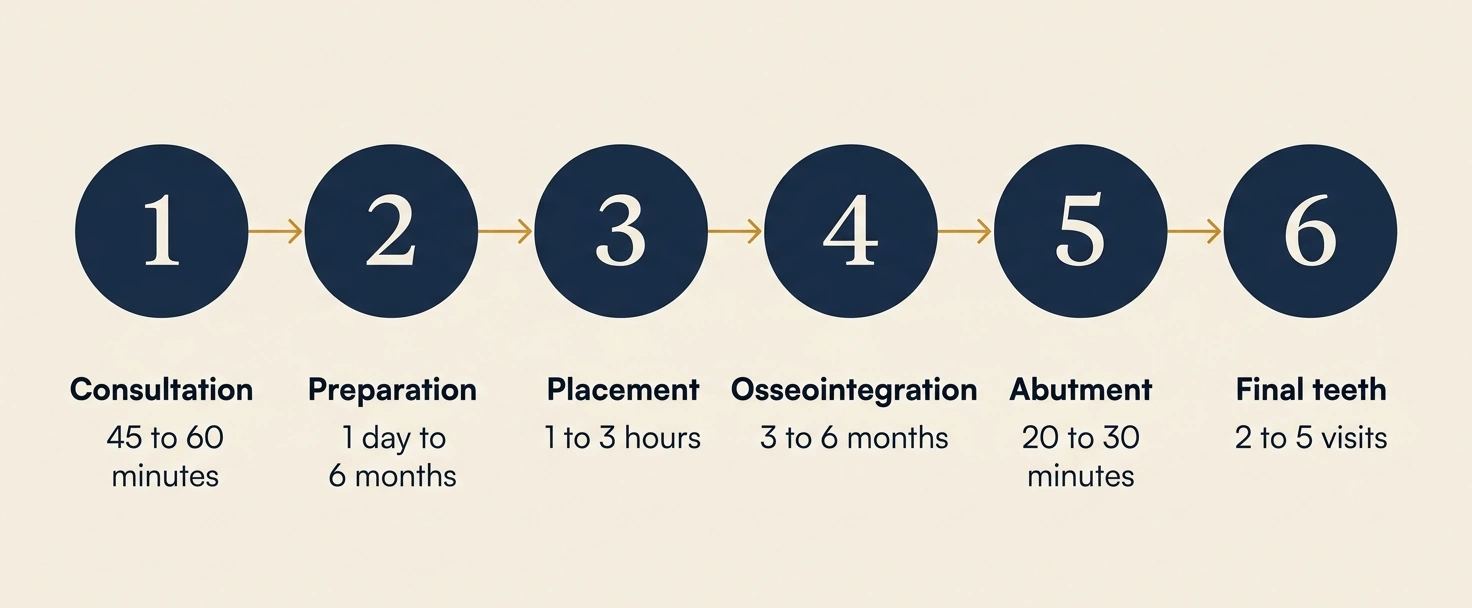
The procedure runs across 5 or 6 stages, with most of the time spent waiting for the bone to heal between visits. The chair time itself is much shorter than people expect.
Consultation and assessment
The first visit is talking, looking, and scanning. Your dentist takes a medical history, asks about medications, examines your mouth and gums, and discusses what you want to achieve. They'll take a cone beam CT (CBCT) scan, which is a 3D X-ray of your jaw. This shows bone density, nerve positions, and sinus locations, all of which the dentist needs before any surgery starts.
The consultation usually takes 45 to 60 minutes. The CBCT itself takes about 20 to 30 seconds, with your head held still in a frame.
You'll leave with a treatment plan and a quote. For implant-focused practices, CBCT is now standard rather than optional.
Preparation procedures
Not every patient needs prep work. If you do, it happens before implant placement, so the site can heal.
The common preparatory procedures:
- Extractions: removing failing teeth. Usually takes 15 to 60 minutes, depending on complexity. Soreness for a few days, soft food, and prescribed pain relief.
- Bone graft: adding bone or bone-substitute material where the jaw is too thin or soft. The procedure usually takes 30 to 90 minutes. Healing varies from 3 to 6 months for major grafts before implants can be placed. Minor grafts often go in the same visit as the implant.
- Sinus lift: raising the sinus floor in the upper jaw to make room for implants. They usually take 60 to 90 minutes in the chair. Healing takes 6 to 9 months before the implant can go in.
Local anaesthetic covers most prep work. IV sedation is common for longer procedures or anxious patients. Recovery looks like a tooth extraction: bruising, swelling, and soft food for a week.
Implant placement surgery
This is the surgical visit people think of when they hear "implant." The dentist opens the gum, drills a precise hole into the jawbone, screws in the titanium implant fixture, and closes the gum either over the implant or around a temporary healing cap.
Chair time depends on the case:
- Single implant: 30 to 60 minutes
- Two to four implants: 60 to 90 minutes
- Full arch (4 to 6 implants per arch): 1 to 3 hours
Most patients describe pressure rather than pain during surgery. Local anaesthetic is the minimum. IV sedation is common, especially for longer procedures. General anaesthetic is used for complex full-arch cases or patients with severe dental anxiety.
Afterwards, you'll have numbness for a few hours, mild bleeding, and swelling that peaks around day 2 or 3. You'll need soft food, prescribed pain relief, and cleaning instructions. If you had IV sedation or general anaesthetic, you can't drive yourself home, and someone needs to be with you for the rest of the day.
Osseointegration and healing
Osseointegration is the process by which your jawbone fuses to the titanium implant. From the outside, nothing seems to be happening. Inside, the implant is becoming a permanent part of your jaw.
The standard timeframe is 3-4 months for the lower jaw and 5-6 months for the upper jaw, where bone tends to be softer. Grafted sites take longer. An implant might fail at this stage if smoking, infection, or compromised healing stops proper bone integration.
You're not toothless during this phase. For full-arch implants, a fixed provisional prosthesis is screwed into the implants on the day of surgery and stays in place through the healing period.
Abutment placement
The abutment is a small connector that attaches to the top of the implant and supports the final crown or prosthesis. Some surgeons place the abutment in the same visit as the implant. Others do it as a separate minor procedure later.
If it's separate, chair time is around 20 to 30 minutes under local anaesthetic. The gum is opened around the implant, the abutment is attached, and the gum heals around it for about two weeks before the final teeth are fitted.
Fitting the final teeth
The last stage is the visible tooth. Your dentist takes impressions or an intraoral scan, the prosthesis is made in a lab or in-house at the clinic, and you come back to have it fitted.
For full-arch, the final prosthesis replaces the provisional teeth fitted on day one. Multiple appointments may be needed for fit, bite, aesthetics, and final polish. It tends to be a more involved finish than a single crown.
Same-day implants vs. traditional protocols
For full-arch cases, you'll be offered one of two pathways: same-day (often marketed as "All-on-4," "All-on-6," or "teeth in a day") or traditional staged surgery.
Same-day full-arch. Extractions, implant placement, and a fixed provisional prosthesis happen in one visit. You leave with teeth. The provisional is replaced with the final prosthesis 3 to 6 months later, once the bone has integrated. Survival rates in well-selected patients sit around 97% in systematic reviews of immediate-load implants.
This approach needs enough bone for primary stability. It's not appropriate for patients with severe bone loss, uncontrolled diabetes, heavy smoking, or active gum disease.
Traditional staged. Extractions and grafting first, then a healing period (3 to 6 months), then implant placement, then osseointegration (3 to 6 months), then the final prosthesis. The path takes 9 to 12 months for a full arch and is the safer route when bone is compromised.
Neither is better. Each fits different situations. The choice depends on your bone, your health, your timeline, and the clinic's recommendation. The right question to ask is: "Why this protocol for my case?"
How long does the procedure take?
The dental implant procedure takes 3 to 12 months from the first consultation to the final restoration.
The full timeline depends on what's being replaced and the condition of the bone. The ranges below assume no major complications.
- Single tooth, straightforward: 3 to 6 months from consultation to final crown.
- Single tooth, requiring bone graft or sinus lift: 6 to 9 months.
- Multiple adjacent teeth (2 to 4): 4 to 8 months.
- Full-arch traditional staged: 9 to 12 months.
- Full-arch same-day (All-on-4): provisional teeth on day one, final prosthesis at 3 to 6 months.
What stretches the timeline:
- Soft bone that needs longer healing
- Bone grafting or sinus lifts
- Slow personal healing
- Delays getting full-arch teeth made in the lab
- Any implant that fails to integrate and needs replacing
What shortens it:
- A stable surgical site
- Good bone density
- Combined surgical stages where possible
How much does the procedure cost in Australia?
A full-arch dental implant procedure in Australia typically costs $25,000 to $45,000 per arch with All-on-4, or $46,000 to $80,000 for both arches replaced.
Cost is the most hidden part of the procedure for most patients. Few clinics publish itemised pricing. The ranges below come from ImplantBridge's review of published Australian clinic pricing through 2025 and 2026. We've cross-checked them against the Australian Dental Association's National Dental Fee Survey. Your case will sit somewhere in these ranges depending on the city, complexity, and clinic.
These figures assume no medical complications. Sedation costs sit on top.
Private health extras cover a part of implant costs as "Major Dental," with a typical 12-month waiting period. Annual Major Dental limits sit between $1,500 and $2,500 on mid-tier and top-tier plans. Some funds also apply lifetime limits on implant items. Your fund's rebate is unlikely to cover more than a small fraction of full-arch treatment.
Medicare doesn't cover dental implants.
DVA Gold and White Card holders can access implants where there's a confirmed clinical need. Standard cover includes single tooth implants and implants used to retain dentures, with limits set in the DVA fee schedule.
Interest-free payment plans (Humm, Afterpay, Zip, National Dental Plan) are widely offered for treatment up to $50,000, depending on the provider. Fees and credit checks apply.
Sedation options and what each one feels like
Sedation often gets less discussion than it deserves. Often it's a single line item and a 30-second mention in the consultation, even when it adds thousands to the bill and changes how the procedure feels.
Local anaesthetic. Numbs the surgical site. You're fully awake. You feel pressure and movement but no pain. Numbness lasts 2 to 4 hours after the procedure. Included in the standard surgical fee. Used for most single implants and many minor bone grafts.
IV sedation (also called twilight sedation or sleep dentistry). A sedative is delivered through a cannula in your arm. You're deeply relaxed, breathing on your own, able to respond to instructions. Most patients have little or no memory of the procedure. Costs around $500 to $1,500 added to your bill, or $800 to $900 per hour for longer procedures. Used for longer procedures, anxious patients, and most full-arch work.
General anaesthetic. A specialist anaesthetist watches your breathing and vital signs the whole time. Done in a hospital or accredited day-surgery setting. Recovery is longer and requires monitoring. Adds $1,000 or more for the anaesthetist plus facility fees. Used for complex full-arch surgery, patients with severe dental anxiety, or specific medical conditions.
Medicare may offer small rebates on the anaesthetist fee in specific circumstances, but the dental treatment itself isn't claimable.
Who the procedure suits
Implants work best for adults who have:
- A fully developed jaw
- Adequate bone density
- Healthy gums
- No active infection or untreated gum disease
- No untreated medical conditions that affect healing
Some factors push a candidate from straightforward into borderline territory. Borderline candidates can still get implants. It usually means more preparation or specialist input before the surgery goes ahead.
Smoking. Smokers have roughly twice the implant failure rate of non-smokers in international meta-analyses. The mechanism is reduced blood flow, slower healing, and higher infection risk. Quitting before surgery and during osseointegration measurably improves outcomes. Most surgeons will ask you to stop smoking at least a few weeks before and after.
Diabetes. Well-controlled type 2 diabetes (HbA1c under about 8%) shows survival rates similar to non-diabetics in published evidence. Poorly controlled diabetes significantly worsens outcomes through impaired healing and higher infection risk.
Osteoporosis medication. If you take medication for osteoporosis or cancer-related bone treatment (common ones include Fosamax, Actonel, and Prolia), tell your dentist before any implant work. These medications can affect how the jaw heals after surgery. Implants aren't ruled out, but your dentist will need to assess the risk in consultation with your treating doctor. The TGA has published safety advice for anyone in this situation.
Bone loss. Significant bone loss after extractions can be addressed with bone grafting or sinus lifts. Severe upper-jaw bone loss might require zygomatic implants, which anchor into the cheekbone and are placed by oral and maxillofacial surgeons in a hospital setting.
Active gum disease. Needs treatment before implants are placed. Otherwise, the bacterial environment that caused the gum disease will compromise the implant site.
Risks and recovery
Implant surgery is a routine procedure for most adults. Like any surgery, it still carries recognised risks. These include:
- Infection at the implant site
- Nerve damage causing temporary or permanent numbness in the lip, chin, or tongue
- Sinus problems from upper-jaw implants placed too close to the sinus floor
- Implant failure, where osseointegration doesn't happen or fails later
- Peri-implantitis, a gum infection around the implant that can develop years afterwards if oral hygiene is poor
Recovery, week by week:
- Days 1 to 3: Swelling and soreness peak around now. You'll manage it with prescribed pain relief, ice, soft food and rest.
- Days 4 to 7: Pain and swelling gradually ease. The soft diet continues, and you'll mouth rinse rather than brush the surgical site directly.
- Week 2: Most of the external healing is done. Non-dissolving stitches come out at this point, and you can start eating firmer food.
- Weeks 2 to 12: The bone slowly integrates with the implant. Nothing changes externally, and normal eating mostly returns by week 4.
Warning signs that warrant a return visit:
- Pain that's getting worse after day 5
- Fever or chills
- Discharge or pus from the surgical site
- Numbness that lasts longer than expected or spreads beyond the surgical area
- Any sense the implant is moving in the bone
Questions to ask before booking
Most clinics offering implants will answer these questions clearly. If a clinic can't or won't, that's information you can factor into your decision.
- Are you a registered specialist for this kind of work, or a general dentist? General dentists can legally place implants. Specialists (periodontists, prosthodontists, oral surgeons, or oral and maxillofacial surgeons) have more postgraduate training in surgical or prosthetic work. You can verify specialty registration for free on the AHPRA public register.
- How many cases like mine have you placed, and what are your recent outcomes? A surgeon who's placed 200 All-on-4 cases in the past 2 years is a different proposition to one who's placed 200 across a 20-year career.
- Which protocol do you recommend for my case, and why? Same-day, traditional staged, or somewhere between. The answer should explain the trade-offs, not just promote one approach.
- What's the full itemised cost? Including consultation, CBCT, implants, abutments, crowns, prosthesis, sedation, and any likely add-ons like bone grafting or sinus lift.
- What sedation options do you offer, and what does each one cost?
- What's your policy if an implant fails? Replacement cost, timeline, and warranty terms.
- What's the follow-up schedule? Most reputable providers monitor implants for years after placement.
Any surgical or invasive procedure carries risks. Before proceeding, seek a second opinion from an appropriately qualified health practitioner.


